 Truffle Hunting in Tuscany
White Truffle vs Black Truffle: The Tuscany Species Compared
White truffle vs black truffle is the first question most visitors to a Tuscan truffle hunt ask, and the answer starts with six species, not two. Tuscany legally harvests the prized white truffle, the black winter truffle, the summer scorzone, the autumn uncinato, the winter black brumale and the spring bianchetto. This page puts them side by side: Latin and Italian names, how each looks and smells, how each is eaten, the legal season in one line and the rough price level in one line. For the full month-by-month calendar see truffle season in Tuscany, and for detailed market prices see what white truffle costs. If you want to be in the woods rather than in the market, compare truffle hunts in Tuscany on the truffle hunting tours in Tuscany.
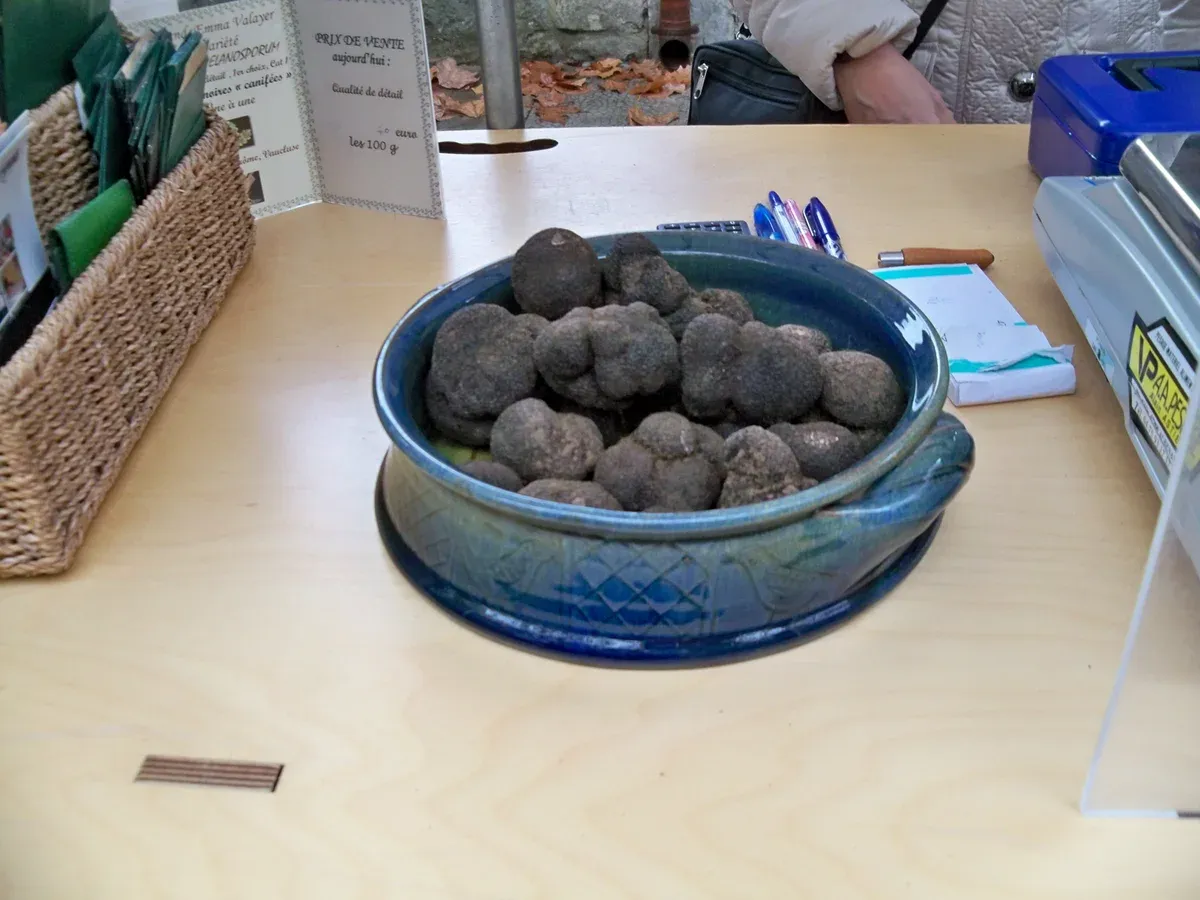
Black winter truffles (Tuber melanosporum) at a market stall. Photo: Véronique PAGNIER, CC BY-SA 3.0, via Wikimedia Commons
Quick answer Six Tuscan species, two that matter, and how each is eaten
The prized white truffle (Tuber magnatum) is the most valuable Tuscan truffle, quoted around €3,000 per kilo in San Miniato during a recent autumn season, while the black winter truffle (Tuber melanosporum) retails at roughly 350 to €600 per kilo. White truffle has smooth ochre skin and a garlic and fermented-cheese aroma, and is always eaten raw and shaved. Black truffle has warty black skin, an earthy chocolate note, and tolerates gentle cooking.
Key takeaways
- See all six species side by side in the comparison table below.
- A white-truffle hunt only runs in autumn, so check truffle season in Tuscany before booking.
- A San Gimignano hunt with lunch and wine pairs the woods walk with a table afterward.
- For a hands-on day, the Chianti hunt with a pasta class runs about one hour with the dog out of a 4-hour visit.
The Six Tuscan Truffles Side by Side
Tuscany's harvest calendar names six species a licensed hunter can legally collect, plus a couple of minor ones. The table below lines up the Italian and Latin names with the one-line season for each, taken from the regional calendar summaries.
Name, Season and Price Level
The legal windows come from the species-by-species calendar attributed to Legge Regionale 2 agosto 2023, n. 36, the current Tuscan truffle law. The price levels are broad retail brackets, and the detailed euro figures per kilo, season by season, live on the dedicated white truffle price page rather than here. Seasons overlap heavily in autumn, which is why an October hunt can realistically meet more than one species in the same wood.
Collection itself is permitted only during daylight hours set month by month on solar time, roughly 7:00 to 18:00 in January widening to about 4:00 to 21:00 in June.
| Truffle | Latin name | Legal season in Tuscany | Price level |
|---|---|---|---|
| White truffle (tartufo bianco pregiato) | Tuber magnatum Pico | 1 October to 15 January | The most expensive, quoted around 2,000 to over €4,000 per kilo in recent seasons |
| Black winter truffle (tartufo nero pregiato) | Tuber melanosporum | 15 November to 15 March | Mid-high, retail roughly 350 to €600 per kilo |
| Summer truffle or scorzone (tartufo d'estate) | Tuber aestivum | 1 June to 31 August, and again 1 October to 30 November | The least expensive, retail roughly 100 to €350 per kilo |
| Autumn truffle or uncinato | Tuber uncinatum | 1 October to 15 January | Low to mid, between scorzone and nero pregiato |
| Winter black truffle (tartufo nero d'inverno) | Tuber brumale | 15 January to 15 April | Low, a lower-value look-alike of nero pregiato |
| Bianchetto or marzuolo | Tuber borchii | 15 January to 15 April | Low, less sought after commercially than magnatum or melanosporum |
Two Minor Species on the Calendar
Operator calendars in Tuscany also list two narrower-market species. Tuber macrosporum appears with its own window, and a musk-scented variant of the winter black truffle, Tuber brumale var. moschatum, has its own too. You are unlikely to meet either on a bookable hunt, but they matter if you shop a fair stall, where a vendor may legally sell whatever is in season that week.
Sources: tartufaisenesi.it, harvest calendar
The White Truffle: Tuber magnatum
This is the truffle that made San Miniato and the Crete Senesi famous, and the one every autumn hunter hopes the dog finds.
How to Recognise It
Tuber magnatum, sold in the trade as tartufo bianco pregiato, is the most valuable of the Tuscan truffles. Its skin, the peridium, is smooth and ochre to pale yellow, with none of the warts you see on black species. Cut it open and the flesh is marbled pinkish brown to pale brown with fine white veins.
The smell is the real identifier: a strong mix of garlic, fermented cheese and gas, a scent that has no black-truffle equivalent. The record for the species is Tuscan. On the night of 26 October 1954, hunter Arturo Gallerini and his dog Parigi found a white truffle near San Miniato weighing 2,520 grams, long cited as the largest ever, and it was sent to US President Dwight D. Eisenhower.
Where and When It Grows
The white truffle grows across a broad belt of Tuscan hill country, from the Lower Valdarno through the Sanminiatesi hills, Valdera, the Volterrano, the Chianti hills, Valdelsa, Val d'Arbia and the Crete Senesi, into parts of the Val di Chiana and Val di Paglia. The older regional law recognised five denominated white-truffle zones: Casentino, Colline Sanminiatesi, Mugello, Val Tiberina and Crete Senesi. The legal season runs 1 October to 15 January across the whole region, the shortest window of the main species and the reason an autumn booking matters.
Full month-by-month detail is on the season calendar page.
How It Is Eaten
White truffle is never cooked. Heat destroys the aroma that makes it expensive, so the whole tuber is shaved raw over the plate at the table, over tagliolini, risotto or a fried egg. This is also why a white truffle must be fresh and why it commands the top price: the value sits entirely in a volatile scent that fades within days.
On a hunt like the San Miniato experience with lunch, whatever the group finds goes straight onto the lunch table shaved raw, which is the most honest way to taste it.
The Black Truffles: Pregiato, Scorzone, Uncinato and Brumale
Four black-skinned species grow in Tuscany, and they are not interchangeable in quality, aroma or price.
Tuber melanosporum, the Nero Pregiato
Known in Tuscany as the black winter truffle or tartufo nero di Norcia and Périgord type, this is the king of the black side. The skin is black and finely warted. The ripe flesh is blackish with a reddish or purple-black tint and fine white veins that darken as it matures.
The aroma is earthy with a slightly chocolatey note, far gentler than magnatum. Its legal Tuscan season runs 15 November to 15 March, so it peaks when the white truffle is finishing. Retail prices have run roughly 350 to €600 per kilo, a fraction of the white.
Tuber aestivum, the Scorzone or Summer Truffle
The scorzone gets its Italian name from its coarse, dark, pyramid-warted skin. The ripe flesh is pale brown to hazelnut with fine white veins that stay white even at maturity, unlike melanosporum's darkening veins. The aroma is mild, described as leavened bread or flour with a peppery, hazelnut note.
This is the truffle a summer visitor will find, with a legal window of 1 June to 31 August and a second window of 1 October to 30 November. It is the least expensive of the regularly sold Tuscan truffles, at roughly 100 to €350 per kilo, which makes it the entry point for anyone buying their first tuber at a market stall.
Tuber uncinatum, the Autumn Form
Tuscan and Italian regulation treats Tuber uncinato, the uncinato, as the autumn-ripening form of the summer truffle. It shares the look of Tuber aestivum but is harvested later, with a legal season of 1 October to 15 January, exactly the same window as the prized white truffle. Aroma-wise it is stronger than a summer scorzone because it ripens in cooler, wetter ground.
It often appears in the same basket as a magnatum find in late autumn.
Tuber brumale, the Winter Black
The tartufo nero d'inverno is a lower-value look-alike of the nero pregiato, with the same dark warty skin, and markets do occasionally confuse the two. The cut flesh gives it away: grey-brown to grey-blackish, with few, wide whitish or beige veins rather than the fine veining of melanosporum. Its season is 15 January to 15 April, so it overlaps the tail of the white truffle window and the whole of the nero pregiato season.
Price sits at the low end of the black range.
Bianchetto: The Second White Truffle
Tuber borchii is white on the outside too, which is exactly why markets and menus can mislead you.
Why It Is Not a Tartufo Bianco Pregiato
The bianchetto, also called marzuolo because it ripens toward March, is a lighter, less prized white truffle. Its legal season is 15 January to 15 April, shared with Tuber brumale, so it fills the late-winter gap when magnatum and melanosporum are finished or finishing. Commercially it is less sought after than either the white truffle or the nero pregiato, and its price reflects that.
One biological quirk matters: it fruits earlier than other species in young plantations, appearing in stands as young as four years old under pine. If a restaurant in March offers white truffle, ask which one, because the honest answer is usually bianchetto at a very different price.
Raw or Cooked: How Each Species Is Eaten
The white versus black split is really a raw versus cooked split, and the Google question about eating black truffles raw gets a direct answer here.
White Truffle, Raw Only
Tuber magnatum and bianchetto are both eaten raw, shaved thinly at the table over a finished dish. The white truffle's aroma compounds are fragile and largely disappear with heat, so Tuscan kitchens treat it as a seasoning, not an ingredient. Classic carriers are egg-based and neutral: tagliolini, risotto, a soft scrambled egg or a plain fonduta.
A few grams per plate is enough, which matters when the raw material runs into the thousands of euros per kilo.
Black Truffle, Gentle Heat Welcomed
Can you eat black truffles raw? Yes, and thin shavings over a finished dish work for Tuber melanosporum too. But unlike the white, the black winter truffle keeps and even develops its aroma under gentle cooking, so it goes into sauces, butter, omelettes and slow-cooked meats.
The scorzone, with its milder flour-and-hazelnut scent, is usually sliced thin raw or lightly warmed, since strong heat would erase what little aroma it has. This is why menus in winter cook the black and never cook the white.
A Word on Truffle Oil
Chefs tend to dislike truffle oil, and the reason is simple. Most commercial truffle oil is not made from real truffle but from synthetic aroma compounds, so it carries none of the complexity of a magnatum or a melanosporum and flattens everything it touches into a single chemical note. None of the species pages in the regional or market sources describe truffle oil as a product of the Tuscan harvest.
If you want the real taste, buy fresh tuber in season or eat it shaved on a hunt, and skip the bottle.
Price Levels: What Each Species Is Worth
The task here is one line per species, and the deep season-by-season numbers belong to the dedicated price page.
Broad Brackets by Species
The market splits cleanly into three tiers. The white truffle sits alone at the top: San Miniato quoted around €2,000 per kilo at the start of a recent season in October, rising to a base of about €3,000 per kilo by November, and in the lean previous season prices went above €4,000 per kilo after dry weather roughly halved the harvestable quantity compared with five or six years earlier. The nero pregiato occupies the middle tier at roughly 350 to €600 per kilo retail.
The scorzone, uncinato, brumale and bianchetto fill the low tier, with the scorzone at roughly 100 to €350 per kilo. For the full picture, including the Alba auction comparison, see white truffle prices explained.
What That Means on a Hunt
A hunt is a demonstration in the woods with a licensed hunter and trained dogs, and nobody can promise a find, especially of the white truffle. Anything dug up belongs to the hunter and the landholder, not the guest, so the price you pay covers the walk and the meal, not the truffle. Experiences differ in what follows the walk: the San Gimignano hunt with lunch and wine tasting is priced at $218 for 3 hours, while a Siena hunt with tasting runs $163.72 for 2 hours without lunch.
Both are honest ways to meet the dogs, and both find whatever species is legally in season on the day.
Which Truffle Should You Hunt or Buy?
There is no single better truffle, only the right species for your dates, your dish and your budget.
If You are in Tuscany between October and mid January and want the famous one
Book an autumn hunt in white-truffle country around San Miniato or the Crete Senesi, and set expectations honestly: the dog may find scorzone or uncinato instead. Start from the Tuscany truffle hunting comparison.
If You are visiting in summer
You will not find white truffle, so aim for the scorzone, the mild summer truffle in its 1 June to 31 August window, and enjoy it at the friendly end of the price scale.
If You want truffle on the plate without buying a whole tuber
Choose a hunt that ends with lunch, like the Chianti hunt with pasta class at $184 for 4 hours, where the shaved truffle is included rather than weighed out per gram.
If You want the deepest aroma for cooking at home
Buy Tuber melanosporo in its 15 November to 15 March season, since it survives gentle heat and costs roughly 350 to €600 per kilo instead of thousands.
If You are on a tight budget and just want to see how the dogs work
Take the shortest format, a 2-hour hunt such as the Siena experience with tasting, and treat whatever species surfaces as the lesson rather than the prize.
White vs Black Truffle: Common Questions
Which is better, white truffle or black truffle?
The prized white truffle is more valuable and more aromatic, with a garlic and fermented-cheese scent that must be eaten raw, while the black winter truffle is cheaper, earthier and can be cooked. Better depends on your dates: the white has a legal Tuscan season of 1 October to 15 January, and the season calendar shows what each month realistically offers.
Is white truffle or black truffle more expensive?
White is far more expensive. San Miniato white truffle was quoted around 2,000 to €3,000 per kilo in a recent season and above €4,000 per kilo in a lean one, while Tuber melanosporum retails at roughly 350 to €600 per kilo. The white truffle price page has the season-by-season figures.
Can you eat black truffles raw?
Yes. Thin raw shavings of Tuber melanosporum work well over pasta or eggs, but unlike white truffle the black also keeps its aroma under gentle cooking, which is why winter kitchens use it in sauces and omelettes. To taste it in the woods first, see a San Miniato hunt with dogs, which ends with a truffle tasting.
Why do chefs dislike truffle oil?
Because most commercial truffle oil is flavoured with synthetic aroma compounds rather than real tuber, so it tastes one-dimensional next to a fresh magnatum or melanosporum. The honest alternative is fresh truffle in season or a meal where it is shaved at the table, such as the San Gimignano hunt with lunch and wine.
What types of truffles grow in Tuscany?
Six main species: the prized white truffle (Tuber magnatum), the black winter truffle (Tuber melanosporum), the summer scorzone (Tuber aestivum), the autumn uncinato (Tuber uncinatum), the winter black (Tuber brumale) and the bianchetto (Tuber borchii), each with its own legal window listed on the season page.
How can you tell a real white truffle from bianchetto?
Both are pale outside, so cut matters and scent matters most. The prized magnatum has smooth ochre skin and a strong garlic and fermented-cheese smell, while the bianchetto is milder, less sought after commercially and ripens from 15 January to 15 April instead of the white's autumn window. Buying at a fair instead? The San Miniato white truffle fair guide explains how the market works.
Will a hunt actually find white truffle?
Not necessarily, and no operator can promise it. A hunt is a demonstration with a licensed hunter and trained dogs, and the species found depends on the legal season on the day, so a summer booking finds scorzone or bianchetto and never magnatum. Compare the honest formats on the Tuscany truffle hunting comparison before choosing dates.