 Truffle Hunting in Tuscany
Truffle Hunting in Italy: Where It Happens and Where to Book
Truffle hunting in Italy is a UNESCO-listed practice that stretches across the country from the northern Apennines to the south, and the two names every traveller weighs are Tuscany and Piedmont. This page explains where the tradition lives, what the national law says, how the white truffle markets of San Miniato and Alba compare, and why Tuscany suits a visitor already based in Florence, Siena or Pisa. It also tells you plainly what a booked hunt is: a demonstration walk with a licensed hunter and a trained dog, usually one to two hours in the woods, with no guarantee of a find. For the full comparison of bookable hunts, see the Tuscany truffle hunting comparison on the homepage.
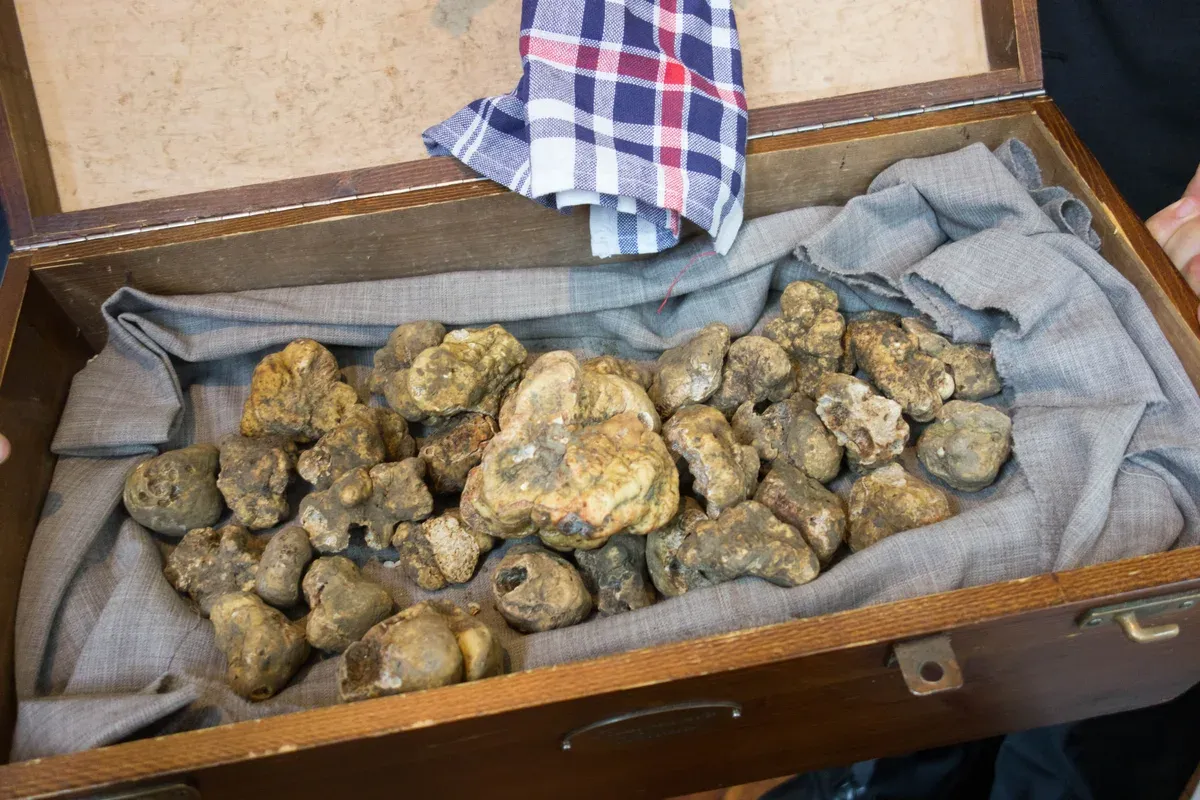
White truffles in a wooden case at Alba, the Piedmont market Tuscany is usually compared with. Photo: Kent Wang from London, United Kingdom, CC BY-SA 2.0, via Wikimedia Commons
Quick answer UNESCO-listed, dog-only by law, and two famous white markets
Truffle hunting in Italy is legally recognised nationwide under Legge 752/1985 and was inscribed on UNESCO's Intangible Cultural Heritage list on 16 December 2021. The two most famous white truffle markets are San Miniato in Tuscany and Alba in Piedmont. For most visitors already in Florence, Siena or Pisa, Tuscany is the easier place to book a hunt.
Key takeaways
- Bookable hunts in Tuscany start from $98 for a 2-hour outing near Volterra, and you can compare truffle hunts in Tuscany side by side.
- Tuscany and Piedmont (Alba) sold white truffle at broadly similar prices in the 2025 season, roughly 1,300 to €3,000 per kilo, so the market does not decide it for you.
- If you want the season calendar for Tuscany month by month, the Tuscany truffle season guide covers it, not this page.
- For a hunt with lunch from Florence, see the Chianti hunt with pasta class and lunch at $184.
Where Truffle Hunting Happens in Italy
Truffle hunting is not a one-region curiosity. The UNESCO inscription and the national law both treat it as a country-wide practice.
A National Tradition, Not a Single Region
The UNESCO listing names two linked practices: cerca, the hunt itself, reading climate, vegetation and soil to find ground where truffles grow spontaneously, and cavatura, the extraction with a small specialised spade called a vanghetto or zappino. The whole method rests on the trained dog's nose and the hunter's ecological knowledge. The dossier describes the practice as spanning the Apennines and reaching across northern, central and southern Italy, so it recognises Tuscan truffle hunting as one branch of a wider national tradition rather than a single destination.
Knowledge is transmitted orally, from experienced hunters to younger ones, through community associations and local museums. The dossier also notes the practice has traditionally been male-dominated in Italy, with growing female participation in recent years, and that hunters protect the woods they work because their income depends on the health of the host trees and the soil.
- Cerca means finding the ground, cavatura means lifting the truffle.
- The tools are a dog, a small spade and a licence.
- UNESCO describes the practice as ecological, since hunters keep the host trees and soil healthy.
The National Law Behind Every Hunt
Collection and commerce in truffles sits under Legge 16 dicembre 1985, n. 752, a national framework law that sets minimum rules each region then implements with its own law. Two national rules shape every hunt you can book. First, the search must be carried out with the aid of a trained dog, and digging is allowed only where the dog has indicated. Second, national law prohibits the use of pigs for truffle searching, a ban that secondary sources attribute to article 9 of the 1985 law, though the full official text could not be confirmed in this research, so we flag that detail as a conflict rather than a verified article number.
Night searching is also banned nationally, defined as the period from one hour after sunset to one hour before sunrise. In Tuscany the regional law is Legge Regionale 2 agosto 2023, n. 36, which replaced L.R. 50/1995. Its implementing regulation was published in the regional bulletin on 10 January 2025 and took formal effect on 25 January 2025. Anyone hunting in Tuscany needs a tesserino, a licence obtained after a 30-hour training course and a written exam where 26 correct answers are needed to pass. Hunting without one brings an administrative fine of 500 to €5,000 under the 2023 law, doubled on repeat offences, up from 150 to €900 under the old law.
- National framework: Legge 752/1985, dog required, pigs banned, night hunting banned.
- Tuscan law: L.R. 36/2023, in force since 25 January 2025.
- Tuscan licence: 30-hour course, written exam, 26 of the questions answered correctly to pass.
- Fine without a licence: 500 to €5,000, doubled on repeat offences.
The Dog Does the Work
Every legal hunt in Italy runs through a dog. Pigs and wild boar can find truffles naturally, but they are hard to control and tend to eat or damage the truffle and the ground around it, which is why dogs replaced them in practice as well as in law. The famous breed is the Lagotto Romagnolo, an old Italian water dog from the marshland at the mouth of the Po river, whose dialect name can lagot means water dog. After 19th-century land reclamation drained the Romagna marshes, the breed was redirected to truffle work.
Italy's kennel club ENCI recognised the Lagotto Romagnolo in 1992, and the FCI gave it official recognition as a truffle-searching breed in 1995, making it the only breed in the world with that official specialisation. On a booked tour you watch exactly the sequence the law describes: the dog casts for scent, the hunter limits digging to the point the dog indicated, and the hole is refilled with the same soil. The dogs and method guide covers the training and the digging technique in detail.
Sources: Ministero della Cultura / UNESCO and Gazzetta Ufficiale, Legge 752/1985
Tuscany vs Piedmont (Alba) as a Place to Book a Hunt
Both regions sit inside the UNESCO tradition and both sell the prized white truffle, Tuber magnatum Pico. The honest comparison is about access, not prestige.
The Two Famous White Truffle Markets
The prized white truffle has two markets with genuine international fame: San Miniato in Tuscany, on a hill roughly midway between Florence and Pisa, and Alba in Piedmont. San Miniato is the best-known white-truffle town in Tuscany, and it carries a record nobody else claims: on the night of 26 October 1954 the hunter Arturo Gallerini and his dog Parigi found a white truffle near the town weighing 2,520 grams, long cited as the largest ever, later given to US President Dwight D. Eisenhower.
At market, the two towns trade in the same species at broadly similar prices. In the 2025 season, ordinary Alba market prices ran from about €1,300/kg for smaller specimens up to €3,000/kg for the most prized, while San Miniato opened its season around €2,000/kg and reached a base of about €3,000/kg by November before the fair pushed it higher. In the lean 2024 season San Miniato prices went above €4,000/kg, because dry conditions roughly halved Tuscan quantities compared with five or six years earlier. Piedmont also stages the charity showcase: the 26th World Alba White Truffle Auction at Grinzane Cavour castle raised €502,000, and the final lot, a 1,009-gram triple truffle from the Roero, sold for €110,000 to a Hong Kong buyer. What any of this means for the truffle in your pasta is unpacked in the white truffle price guide.
Side by Side
The table below compares the two regions on the points that actually change a booking decision, using the figures and statements in the research pack only. Where the pack gives no equivalent Piedmont figure, the cell says so. Read it as a starting point: both regions can deliver a genuine hunt with a licensed hunter and a dog, and neither can promise you a white truffle on the day.
Comparison
The figures come from the 2025 season price coverage and the transport data in the research pack. Market prices are per kilo of white truffle and swing with weather, so treat them as seasonal records rather than promises.
Sources: La Nazione / Il Tirreno on San Miniato 2025 prices and Mentelocale on the 2025 Alba auction
Tuscany and Piedmont Compared on the Facts That Matter
This table sets the two regions against each other on the white truffle market, the 2025 season prices, the record stories and the access from major cities, using only figures and statements from the research pack. Where the pack holds no Piedmont equivalent, the cell says not stated.
| Point | Tuscany (San Miniato) | Piedmont (Alba) | Book |
|---|---|---|---|
| White truffle market | San Miniato, best-known white-truffle town in Tuscany | Alba, plus the World Alba White Truffle Auction at Grinzane Cavour castle | |
| 2025 season price | About €2,000/kg at the season opening, about €3,000/kg as a base by November | About €1,300/kg for smaller specimens up to €3,000/kg for the most prized | |
| Lean-season record | Above €4,000/kg in the 2024 season after dry weather halved quantities | not stated | |
| Famous story | The 2,520 g record truffle of 1954, given to President Eisenhower | The 2025 auction final lot, a 1,009 g truffle that sold for €110,000 to a Hong Kong buyer | |
| Rail access from a major city | About 43 minutes from Firenze Santa Maria Novella, roughly 45 direct trains a day, about 27-31 minutes from Pisa Centrale | not stated |
Why Tuscany Suits a Visitor in Florence, Siena or Pisa
If you are already in central Tuscany, a booked hunt is a short trip rather than a domestic flight plus a transfer.
Truffle Country Starts at the City Limits
The prized white truffle grows across a broad belt of Tuscan hill country running from the Lower Valdarno through the Sanminiatesi hills, Valdera, the Volterrano, the Chianti hills, Valdelsa, Val d'Arbia and the Crete Senesi, into parts of the Val di Chiana and Val di Paglia. That belt brushes up against Florence, Siena and Pisa, which is why the bookable hunts on this site start in San Miniato, San Gimignano, Chianti, the Siena hills and Peccioli near Volterra. The older regional law recognised five denominated white-truffle zones: Casentino, Colline Sanminiatesi, Mugello, Val Tiberina and Crete Senesi.
One conflict is worth naming. Popular travel copy often groups Val d'Orcia with the Crete Senesi as a white-truffle area, but the legal zone list from L.R. 50/1995 does not name Val d'Orcia as a separate denominated zone, so we treat that grouping as marketing rather than law. A separate summary on the Mugello and Casentino zones describes a collection window of 10 September to 31 December that does not match the per-species windows in the regional calendar, and that discrepancy could not be traced to a specific article. For the per-species windows we do use, go to the Tuscany truffle season guide.
Getting to a Hunt Without a Car
Most hunts start at a farm in the countryside and include no transport, so a carless visitor either pays a taxi or books one of the transfer tours. The rail option is genuinely good for San Miniato. The train from Firenze Santa Maria Novella to San Miniato-Fucecchio takes about 43 minutes on average, with roughly 45 direct trains a day, and from Pisa Centrale it takes about 27-31 minutes with roughly 43 direct trains a day. The station sits in the valley below the hilltop old town, reached by local bus or an uphill walk.
The transfer tours solve the problem for you. The full-day small-group tour from Florence at $391.75 covers a hunt near San Miniato, a two-course lunch and a Chianti wine tasting in a 7-hour day with minivan transport between stops, and the San Gimignano day trip from Florence at $316 runs 8 hours with round-trip van transport and is capped at 8 participants. If you base yourself in Siena instead, the Siena hunt at Porta Romana at $163.72 meets on foot at the gate, no car needed.
What You Actually Book
A booked hunt in Tuscany is a demonstration, not a guarantee. A licensed hunter and a trained dog walk you through their woods, usually for about one to two hours of the total time, and the rest of a typical experience is a tasting or a meal. Nobody can promise a find, and that is doubly true for the white truffle, whose legal Tuscan season runs 1 October to 15 January. Book a hunt in spring or summer and the dogs will work black summer truffle or bianchetto instead, because the white truffle is not legally or practically findable outside its window.
The walk itself is weather-dependent. October in inland Tuscany averages about 4.3 inches of rain over roughly 6 days, and November brings average temperatures around 11°C with roughly 5.7 inches of rain spread over about 7 days. That means wet leaf litter, mud and puddles under the oaks, which is why local guides recommend proper waterproof boots for any accompanied hunt around San Miniato or the Crete Senesi.
Tuscany or Piedmont: Which Should You Book
The pack supports a clear split by traveller situation rather than by prestige.
If You are already in Florence, Siena or Pisa
Book in Tuscany, where the train to San Miniato-Fucecchio takes about 43 minutes from Florence, or choose a transfer tour like the full-day small-group hunt from Florence.
If You want the cheapest booked hunt in this comparison
The 2-hour Peccioli hunt near Volterra at $98 is the lowest price, though it requires getting to the farm at Via della Bonifica 156.
If You want the most documented hunt-and-lunch experience
The San Miniato hunt with lunch at $233.88 carries 391 reviews at a 4.9 rating, but note that all sales are final and no transport is included.
If You are chasing the white truffle specifically
Book between 1 October and 15 January, the legal Tuscan window for Tuber magnatum, and accept that no guide can promise a find.
If You are travelling in spring or summer
Book in Tuscany for black summer truffle or bianchetto and drop the white-truffle expectation, or push the trip to autumn instead.
If You are set on Alba and Piedmont
The pack documents Alba's market and its charity auction but holds no details on bookable Piedmont hunts, so we cannot compare specific listings for that region.
Questions About Truffle Hunting in Italy
Where is the best truffle hunting in Italy?
The UNESCO inscription covers the whole country, and the two most famous white truffle markets are San Miniato in Tuscany and Alba in Piedmont, which sold at broadly similar prices in the 2025 season. For practical booking, Tuscany wins for most visitors because the hunts sit within reach of Florence, Siena and Pisa, and you can compare them on every truffle hunt in Tuscany.
How much does it cost to go truffle hunting in Italy?
In the Tuscan comparison on this site, booked hunts run from $98 for a 2-hour outing near Volterra up to $391.75 for a 7-hour full day from Florence with transport and a wine tasting. A mid-point is the Chianti hunt with pasta class and lunch at $184 for 4 hours.
How much is 1 lb of truffle worth in Italy?
Market prices are quoted per kilo in euros. In the 2025 season San Miniato white truffle moved from around €2,000/kg to a base of about €3,000/kg by November, and Alba ranged from about 1,300 to €3,000/kg, so a pound (454 g) at €3,000/kg works out to roughly €1,360 at that market level. Season and size swing the figure enormously, as the white truffle price guide explains.
Is truffle hunting in Italy worth it?
It is worth it if you book it as a walk in working woods with a licensed hunter and a trained dog, usually 1 to 2 hours of hunting inside a longer experience, and not as a truffle-guarantee scheme. Nobody can promise a find, least of all the white truffle. Within that framing, ratings on the Tuscan listings are strong, including 391 reviews at 4.9 for the San Miniato hunt with lunch.
Is truffle hunting legal in Italy and who regulates it?
Yes, it is legal and nationally regulated under Legge 752/1985, which requires a trained dog, bans pigs and bans night searching, while regions implement their own laws. In Tuscany that law is L.R. 36/2023, and hunting without the regional tesserino licence carries a fine of 500 to €5,000. The dogs and the method behind all this are covered in the truffle hunting dogs guide.
Is the Italian truffle tradition really UNESCO-listed?
Yes. Truffle hunting and extraction in Italy was inscribed on UNESCO's Representative List of the Intangible Cultural Heritage of Humanity on 16 December 2021, after entering the national inventory in March 2020. The listing describes cerca and cavatura as one practice spanning the Apennines across northern, central and southern Italy, which includes every Tuscan hunt in this comparison.
Can I combine a hunt with a white truffle market in Italy?
In Tuscany, yes. San Miniato's Mostra Mercato Nazionale del Tartufo Bianco runs on three consecutive November weekends in its 55th edition, in the hilltop old town around Piazza del Popolo, and San Giovanni d'Asso in the Crete Senesi holds its 40th edition on two November weekends. The San Miniato white truffle fair guide lists the fair weekends in one place.