 Truffle Hunting in Tuscany
Truffle Hunting Dogs in Tuscany: Breeds, Training and the Law
Truffle hunting dogs are the only legal way to search for truffles in Italy. National law bans pigs and requires a trained dog, and in Tuscany the dog you will most often meet on a hunt is the Lagotto Romagnolo. This guide explains why dogs replaced pigs, how a Lagotto is trained and rewarded, how a truffle is actually located underground and lifted with the small spade, and what rules bind the hunter and the dog. It also covers the tesserino, the licence every Tuscan truffle hunter must hold. If you want to compare the bookable hunts themselves, see the truffle hunting in Tuscany comparison on the homepage. For which truffles are in season when you travel, the separate season guide covers the calendar, and it sits alongside what a truffle hunt in Tuscany costs end to end.
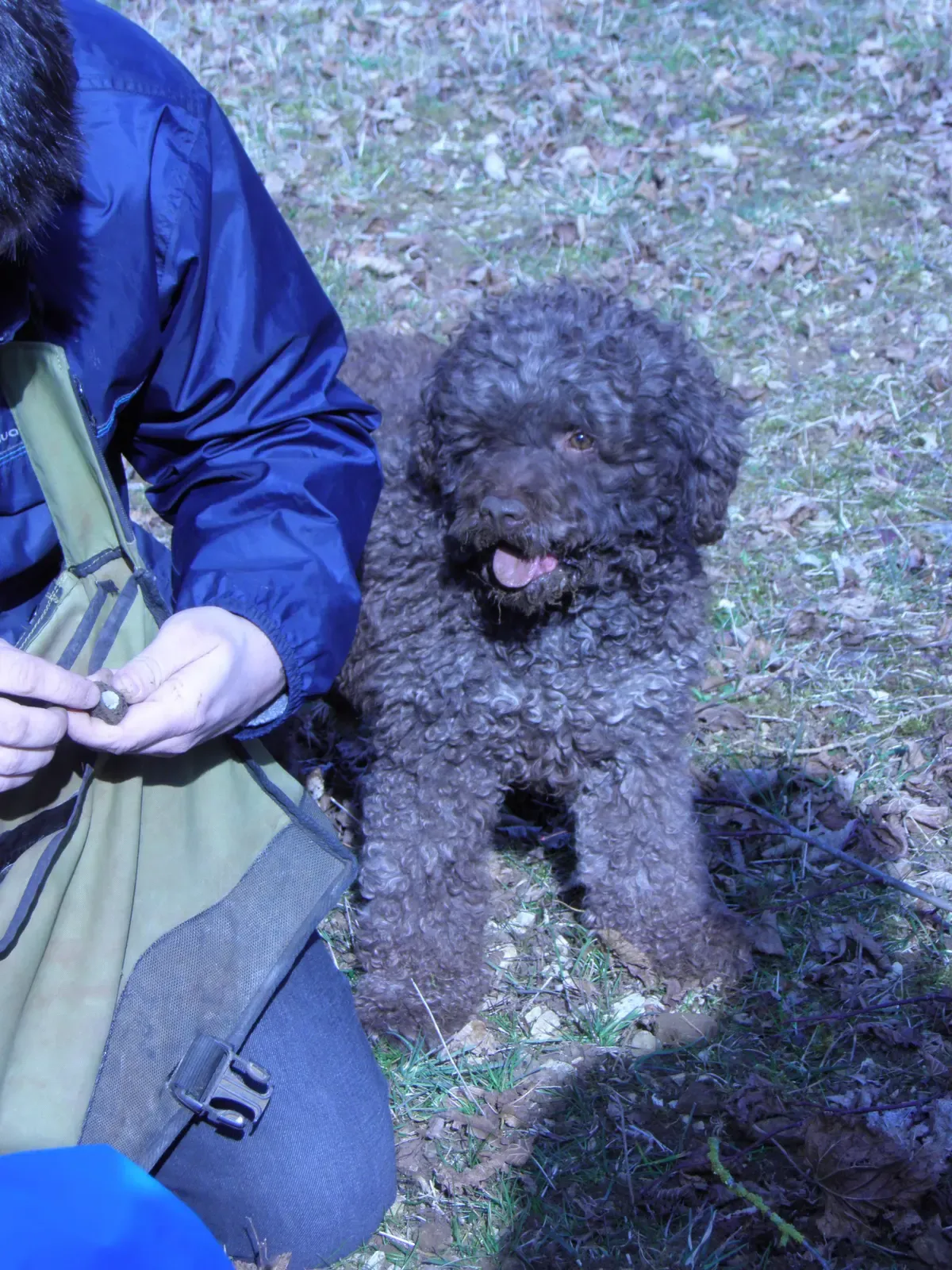
A Lagotto Romagnolo searching for truffles, photographed in Burgundy, France. Photo: Gzen92, CC BY-SA 4.0, via Wikimedia Commons
Quick answer Why dogs and not pigs, and what the Lagotto actually does
Italy hunts truffles with dogs because national law (Legge 752/1985, art. 9) bans pigs and requires a trained dog for the search. The classic breed is the Lagotto Romagnolo, the only breed officially recognised by the FCI in 1995 as a truffle-searching specialist. A Tuscan hunter may work with at most two dogs at a time. On a typical tour you watch the dog work the woods for about 1 hour of a 2-4 hour experience.
Key takeaways
- See how the hunt itself works on a real listing: San Miniato hunt with Francesca and her dog.
- The licence behind every hunter is explained in the tesserino section below.
- Which species the dog can find in your month is set out in the Tuscany truffle season guide.
- To pick a hunt by town, price and group size, compare truffle hunts in Tuscany on the Tuscan truffle hunt list.
Why Italy Hunts Truffles With Dogs, Not Pigs
The pig is the historical truffle animal of France, but in Italy it has been legally excluded for decades.
The national ban
The national framework law for truffles, Legge 16 dicembre 1985, n. 752, prohibits the use of pigs for searching and collecting truffles. Multiple Italian secondary sources attribute the ban to article 9 of that law. Note an honest qualification: the official Gazzetta Ufficiale text could not be read in full during research, so the article number rests on those secondary sources rather than a direct reading of the statute. The law also requires the opposite side of the rule, that the search be carried out with the aid of a trained dog, and that digging is only allowed at the point the dog has indicated. In practice this means every legal truffle hunter in Tuscany works with a dog, and the dog is not decoration but the legal instrument of the hunt.
The practical reasons match the legal one. Pigs and wild boar find truffles naturally without any training, but they are hard to control once the scent is found. They tend to eat the truffle or damage it and the ground around it. A dog that is trained to indicate and to wait can be rewarded instead, so the truffle comes out whole and the site stays usable for future seasons.
Recognition as cultural heritage
The practice of hunting and extracting truffles with dogs was inscribed on UNESCO's Representative List of the Intangible Cultural Heritage of Humanity in 2021, on 16 December 2021. The UNESCO dossier breaks the practice into two linked parts: cerca, the hunt, meaning reading the ground to identify where truffles grow spontaneously, and cavatura, the extraction with a specialised spade. Both rest on the trained dog's sense of smell combined with the hunter's knowledge of climate, vegetation and soil.
The inscription covers Italy as a whole, from the Apennines across northern, central and southern regions, so Tuscan truffle hunting is recognised as part of one national tradition. UNESCO also notes the knowledge is transmitted orally, from experienced hunters to younger ones, and that the practice helps maintain ecological balance in the woods because hunters protect the health of the host trees and soil.
Sources: Legge 752/1985, UNESCO dossier
The Breeds: Lagotto Romagnolo and Beyond
One breed dominates Italian truffle hunting and carries an official title no other breed holds.
The Lagotto Romagnolo
The Lagotto Romagnolo is an old Italian breed from the marshland at the mouth of the Po river in Romagna. The dialect name can lagot means water dog, and the breed's first job was retrieving waterfowl. After 19th-century land reclamation drained the Romagna marshes, that retrieving work disappeared and hunters turned to the dog's other asset, a strong nose, and retrained it as a dedicated truffle dog.
Italy's kennel club ENCI gave the breed recognition in 1992, and in 1995 the FCI (Fédération Cynologique Internationale) recognised it as a truffle-searching breed, which makes it the only breed in the world with that official specialisation. On tours across Tuscany this is the dog you are most likely to meet. The Chianti hunt at Cofferi 1242 names its Lagotto Romagnolo directly in the listing, as does the Siena hunt with Alessandro and the San Miniato hunts.
Other breeds and mixed dogs
The research behind this page documents the Lagotto Romagnolo in detail. Beyond it, Italian truffle hunters do use other breeds and mixed dogs, and the law does not restrict which breed may work, only how many dogs a hunter may take. If the breed on a specific tour matters to you, the honest answer is that tour listings on the comparison mention the Lagotto by name but do not systematically state the breed for every operator, so ask the operator before booking.
One famous Tuscan truffle dog is recorded by name in local history: Parigi, the dog of hunter Arturo Gallerini, who on the night of 26 October 1954 found a white truffle near San Miniato weighing 2,520 grams, long cited as the largest ever found and later given to US President Eisenhower.
How a Truffle Dog Is Trained and Rewarded
Training turns a natural nose into a legal working method: find, indicate, wait for the hunter, take the reward.
From puppy to working dog
The UNESCO dossier describes truffle-hunting knowledge as transmitted orally across generations, from experienced hunters to younger practitioners, and dog training follows the same pattern. A young dog learns the scent of ripe truffle and is shaped toward a clear indication behaviour, usually pawing or sitting at the spot. The key the law builds on is control: the trained dog must indicate the point and let the hunter dig, rather than digging or eating the find itself.
Under Tuscan regulation a single hunter may work with a maximum of two dogs at a time, and one of those two may be a dog still in training, which is how young dogs get their field experience alongside an experienced animal. Training courses run by community associations and local museums are part of how the practice passes on, alongside what hunters teach their own dogs at home.
The reward
What exactly a hunter feeds as a reward is not stated in the sources behind this page, and practices vary from handler to handler. What the sources do make clear is the structure the reward supports: the dog is paid for indicating, not for digging, because a digger destroys both the truffle and the mycelium-bearing soil around it. You can see the result on any listed hunt.
On the Peccioli hunt near Volterra the hunter, certified since 2008, lets visitors dig out a located truffle themselves under his direction. On the San Miniato Nacci Tartufi hunt the operator states the duration varies from 90 minutes to 3 hours depending on the dogs, a reminder that the animals set the pace of the day.
How a Truffle Is Actually Found and Lifted
A find has three stages: the scent at ripeness, the dog's indication, and the careful lift with the small spade.
The tree, the soil and the scent at ripeness
A truffle is the underground fruiting body of a fungus that lives in symbiosis with the roots of host trees, which is why hunters work specific woods rather than random ground. UNESCO frames the hunter's role as ecological knowledge: reading climate, vegetation and soil to identify ground where truffles grow spontaneously, called cerca. The truffle gives off its strong aroma only as it ripens, and that aroma is what the dog detects through the soil.
Depth at which each species sits is not stated in the sources behind this page, so beware any guide that quotes a fixed depth. What the dog smells is the ripe truffle, not the tree, which is why an untrained animal or a pig cannot substitute for a trained indication. Which truffle species your month's hunt can legally target, from the summer scorzone to the prized white truffle, is laid out in the species and season guide, and how the species differ in look and use is covered in white vs black truffle.
The vanghetto and the refill rule
Once the dog indicates, the hunter digs by hand with a specialised small spade. In the UNESCO dossier the tool is called a vanghetto or zappino depending on the region. Tuscan regulation caps it precisely: the vanghetto or vanghella used in Tuscany may have a blade no more than 5 centimetres long and wide.
The second rule matters as much as the first: any hole opened must be refilled immediately with the same soil. This protects the mycelium in the ground so the same spot can produce again in later seasons, and it is the reason UNESCO describes the practice as helping maintain ecological balance in the woods. Digging is legally allowed only at the point the dog has indicated, so a hunter who starts loosening soil elsewhere is outside the law.
The Tesserino: The Hunter's Licence and the Dog Rules
Every legal hunter in Tuscany holds a licence called the tesserino, and the law caps the number of dogs that may work with one hunter.
Getting the licence
Searching for and collecting truffles anywhere in Tuscany requires a tesserino, obtained after a training course and a qualifying exam registered through the region's EDART platform. The course for a first licence runs 30 hours, and renewal after the licence's validity period requires an 8-hour refresher course. The exam is written only, and a candidate must answer at least 26 questions correctly to pass.
In the municipality of Vinci the tesserino is valid for 10 years and requires an annual payment of €92.96 (about $107) to the Tuscany Region each calendar year, and applicants must be at least 16 years old. Hunting without the licence under the current regional law, L.R. 36/2023, brings an administrative fine of €500 (about $570) to €5,000 (about $5,750), plus a one-year suspension of the licence and seizure of the truffles, with fines doubling on repeat offences. For comparison, under the older L.R. 50/1995 the fine was only €150 (about $172) to €900 (about $1,030).
The rules that involve the dog
Three rules bind the hunter-and-dog team directly. First, the search must be carried out with the aid of a trained dog, and digging is allowed only where the dog indicates. Second, a single hunter may work with at most two dogs at a time, one of which may be in training.
Third, national law bans collection at night, defined as the period from one hour after sunset to one hour before sunrise, and Tuscany sets permitted digging hours month by month on solar time, roughly 7:00-18:00 in January widening to about 4:00-21:00 in June. The regional framework is Legge Regionale 2 agosto 2023, n. 36, which replaced L.R. 50/1995 and updated the harvest calendar for climate change. Its implementing regulation took formal effect on 25 January 2025.
Sources: Comune di Vinci, Tesserino Raccolta Tartufi, Regione Toscana
What You Watch the Dog Do on a Tour
A bookable hunt is a demonstration: the licensed hunter and the dogs work a real wood while you follow.
The shape of a hunt
Be honest with yourself about what a hunt is: a walk in the woods with a licensed hunter and trained dogs, and nobody can promise a find, especially of the white truffle. The dog ranges ahead working the ground, catches the scent of a ripe truffle, and indicates the spot. The hunter then lifts the truffle with the vanghetto, refills the hole with the same soil, and usually lets you see and smell the find close up.
Some operators go further and let you do the digging yourself under direction. The listed experiences vary in how much time is actually spent with the dogs, and the figures below come from each listing as published on its booking platform.
Dog time across the listings
The table compares how much of each experience is actually spent with the hunter's dogs in the woods, taken from the time_hunting detail each operator publishes. It is not a price comparison, which you can run on the homepage. Notice the pattern: most operators book about 1 hour of dog work inside a longer day built around lunch or a tasting, and one hunt dedicates nearly all its running time to the dogs themselves.
| Tour | Town | Total duration | Time with the dogs |
|---|---|---|---|
| Siena Tartufi hunt | Siena | 2h | About 1h 20m with Alessandro and his dogs |
| Chianti hunt and pasta class | Chianti | 4h | About 1 hour with the Lagotto Romagnolo |
| San Miniato hunt with lunch | San Miniato | 3h | About 1 hour walking with Francesca's dog |
| Nacci Tartufi hunt and tasting | San Miniato | 1h 30m - 3h | Variable, depends on the dogs |
| Peccioli hunt near Volterra | Peccioli | 2h | Not stated as a separate figure |
| Le Pietre Vive hunt | Castelnuovo Berardenga | 2h | Not stated as a separate figure |
Do and Don't Around a Working Truffle Dog
The dogs are working animals. A few habits from visitors make their job easier or harder.
Do
- Do let the dog work ahead and follow at the hunter's pace, because the dog ranges freely over the ground it is searching.
- Do ask before touching or greeting the dog, since a working animal mid-search can lose the scent thread.
- Do wear closed waterproof boots, because autumn truffle woods mean wet leaf litter and mud under the trees.
- Do watch where the hunter digs and how the hole is refilled, because that 5-centimetre blade and immediate refill are the sustainable method.
Don't
- Don't bring your own pet dog on a booked hunt, because the listings cap working dog numbers at two per hunter and a strange animal disrupts them.
- Don't feed or reward the dog yourself, since the reward is tied to the indication behaviour the hunter is training.
- Don't dig anywhere yourself unless the hunter invites and directs you, because the law allows digging only at the dog's indicated point.
- Don't expect a guaranteed find, because no hunter can promise a truffle on any given walk, least of all a white truffle.
Questions About Truffle Hunting Dogs
What breed of dog hunts for truffles?
The classic breed is the Lagotto Romagnolo, an old Italian water dog from the Romagna marshes that was retrained for truffle work after the marshes were drained. In 1995 the FCI recognised it as a truffle-searching breed, the only breed in the world with that official specialisation. You can meet one on the Chianti hunt, which names its Lagotto in the listing: see the Chianti hunt and pasta class.
Is it legal to hunt truffles with dogs in Italy?
Yes, and it is the only legal way. National law, Legge 752/1985, bans pigs and requires the search to be carried out with a trained dog, with digging allowed only where the dog indicates. Every licensed hunter on the Tuscany truffle hunting comparison works within these rules.
Why are pigs banned from truffle hunting in Italy?
Legge 752/1985, article 9 according to Italian secondary sources, prohibits pigs for truffle search and collection. The practical reason matches the legal one: pigs find truffles without training but are hard to control and tend to eat or damage the truffle and the ground around it. Dogs indicate and wait, which is what you watch on a San Miniato hunt with lunch.
How many dogs can a truffle hunter use?
Under Tuscan regulation a single hunter may work with a maximum of two dogs at a time, and one of the may be a dog still in training. That limit is why group hunts run with one handler and one or two animals. The small-group Siena hunt runs at up to 8 travelers with Alessandro and his dogs: Siena Tartufi hunt.
How much does a truffle sniffing dog cost to buy?
Not stated. The sources behind this page cover the breed history, the law and the licence, but no price for purchasing a trained Lagotto Romagnolo or any other truffle dog was found, so any figure you read elsewhere should be treated with caution. What is documented is the hunter's side: the tesserino licence costs €92.96 (about $107) per year and fines for hunting without it run from €500 (about $570) to €5,000 (about $5,750).
How does a dog find a truffle underground?
A ripe truffle gives off a strong aroma through the soil, and the trained dog scents it, indicates the spot and waits. The hunter then lifts it with a vanghetto, a small spade limited in Tuscany to a 5-centimetre blade, and refills the hole immediately with the same soil. Which species the dog can legally target in your month is set by the harvest calendar in the Tuscany truffle season guide.
Do I need a licence to join a truffle hunt as a visitor?
No. The tesserino is the hunter's licence, and on a bookable experience you walk with a licensed hunter whose tesserino covers the search. Visitors simply follow the dog and the handler. To choose an experience by town and format, start from the Tuscan truffle hunt list rather than applying for any licence yourself.